
Female masturbation remains a sensitive subject, still surrounded by silence and embarrassment, even though it is part of the body's natural functioning. When I talk about female masturbation, I mean a simple act: discovering yourself, understanding your sensations, and learning to listen to your body without pressure. Yet despite social progress, this subject is still often pushed aside. In this article, I'll go over all the basics with you, but also take things further: understanding where this taboo comes from, what science really tells us, and why this practice deserves to be viewed differently.

Female masturbation remains taboo, despite major advances in sexual liberation. Although male pleasure has long been normalized, women's pleasure still faces cultural, social, and psychological obstacles. Talking about female masturbation without shame or embarrassment is essential to normalizing this practice, which benefits women's physical and mental well-being. Let's explore the reasons behind this taboo, the lesser-known benefits of masturbation, and why this practice should not be seen as a threat to a relationship, but rather as something positive for both partners.
If you want to better understand your body, you can also consult the clitoris guide, which explains the areas of stimulation and how they work in detail. For an even more in-depth approach, the article the clitoris: small organ, great misunderstanding explains everything that real anatomy reveals—and what is far too rarely taught.
1. Why is female masturbation still taboo?
Cultural and religious heritage

For centuries, female sexuality has been confined by moral and religious constraints. In many societies, female pleasure was considered illegitimate or secondary, reinforcing the idea that a woman's role was limited to that of a mother or wife. Masturbation, perceived as a solitary act of self-pleasure, therefore went against this traditional social role. While male pleasure was largely tolerated, female pleasure remained marginalized.
This historical context has left deep traces. Even today, some beliefs persist unconsciously, influencing the way women perceive their own desire. Many women masturbate in silence, without talking about it, sometimes even with a lingering sense of guilt they cannot really explain. Understanding its origins is already a step toward gaining perspective and freeing yourself from these expectations.
Historical research also shows that some periods were more permissive than others. Ancient Rome and India (with the Kama Sutra) valued female pleasure. It was mainly in recent centuries, marked by a restrictive view of sexuality, that the taboo as we know it today took hold. In other words, this silence is not a universal truth but a cultural construct that can be dismantled.
Gender stereotypes and perceptions of the body

The lack of representations of female masturbation in the media and popular culture also contributes to this taboo. While male masturbation is often portrayed as comical, ordinary, and even “normal,” female masturbation is rarely shown—or is shown in highly sexualized contexts intended for male pleasure. This underrepresentation fuels a general lack of understanding and perpetuates the idea that it is an abnormal or marginal act.
The problem goes further: when women who masturbate are represented, it is often for an outside gaze. The pleasure is not theirs; it becomes a spectacle. This confusion between intimate practice and performance perpetuates the idea that female masturbation must necessarily be aesthetic, eroticized, and performative. In reality, masturbation is often messy, pragmatic, and sometimes very quick. Just like men's, in fact.
You can also explore this topic further with this article: pornography and influence, which shows how much representations of female sexuality on screen distort real-life expectations and practices.
2. The benefits of female masturbation
A powerful stress reliever

Masturbation stimulates the release of endorphins, the hormones of well-being, thereby reducing anxiety and tension. This simple act also promotes better sleep by relaxing the muscles and lowering the level of cortisol, the stress hormone.
Recent studies confirm that regular masturbation is associated with better sleep quality, a significant reduction in perceived stress, and even a positive effect on menstrual pain. Orgasm triggers a hormonal cascade (oxytocin, endorphins, prolactin) that acts as a natural anxiolytic. Many women also use masturbation as a way to fall asleep, and this is perfectly legitimate from a physiological perspective.
To explore well-being further, you can read this article about massage and relaxation.
Self-knowledge

Exploring their own bodies allows women to better understand their sexual preferences and discover what gives them pleasure. By knowing their bodies, women can communicate their needs to their partners more easily.
This is probably the most underestimated benefit. A woman who knows her body knows what to say, what to ask for, and how to guide. She does not passively wait for the other person to guess—she actively participates in shared pleasure. This is also why sexologists often recommend masturbation to women who have difficulty reaching orgasm with a partner: you first need to know what works for you before hoping someone else will discover it in your place. The article faking pleasure also explores this reality that many people experience in silence.
It can also boost confidence. I explain everything here: how to feel more confident in bed.
Physical health

Masturbation stimulates blood circulation in the pelvic area, which can help prevent certain discomforts associated with stagnation. It also helps maintain pelvic floor tone, which is particularly important after childbirth or approaching menopause. Women who maintain an active sex life, whether partnered or alone, generally retain better lubrication and sensitivity over the years.
Ben Wa balls are also an excellent starting point: they combine pelvic floor strengthening with intensified sensations.
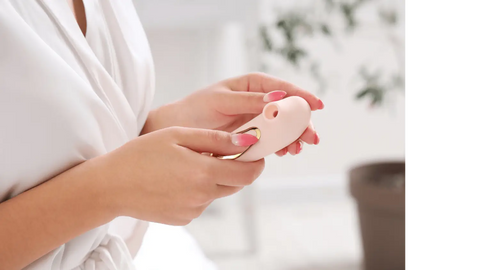
Certain accessories can support this exploration: clitoral stimulators for precise external stimulation, clitoral suction stimulators for a different sensation without direct contact, or dildos for vaginal stimulation. There is a wide selection in the women's sex toys category, and the right choice depends above all on what you want to explore.
For those going through specific life stages, the article on menopause and sexuality and the article on pelvic floor rehabilitation offer additional insight into how the body changes throughout life.
3. Female masturbation and relationships
Breaking down misconceptions

Some men see female masturbation as a form of betrayal or as an indication that they are unable to satisfy their partner. In reality, this is a misconception. Masturbation and sex as a couple are not competitors: they meet different needs. Masturbating does not mean that your partner is inadequate, any more than eating a sandwich at lunchtime means that you no longer enjoy evening meals.
Sexology studies even show the opposite: women who masturbate regularly generally report a more fulfilling sex life as a couple. They know their bodies better, express their desires more easily, and have more consistent desire over time. Masturbation enhances sex between partners; it does not replace it.
Connection and communication

Couples who talk openly about their sexual needs develop a relationship based on transparency. Being able to say “I like this sensation” or “I need more time here” transforms sex between two people: the partner no longer has to guess, and the woman no longer has to fake it to hurry through something that is not working. This dialogue is easier to begin when each person already knows their own body.
Some couples go further and incorporate toys into their shared intimacy. This is not an admission of failure; it is an opening. Watching your partner pleasure herself, or using a couples’ sex toy together, can become a powerful source of connection.
If you want to explore relationship dynamics further, you can read the couples’ guide.
4. How can female masturbation be normalized?
Sex education

To help young people develop a healthy relationship with their bodies, it is essential to address these topics without embarrassment. Sex education that excludes female pleasure inevitably conveys the message that this pleasure does not exist or is not important. Including the clitoris in anatomical diagrams, explaining that masturbation is normal, and discussing the diversity of sensations are simple yet foundational educational steps.
Countries that have implemented comprehensive sex education, such as the Netherlands and Sweden, show far better outcomes: less sexual violence, fewer teenage pregnancies, and greater relationship satisfaction in adulthood. Knowledge protects; silence weakens.
Giving women a voice

Many women hesitate to talk about their experiences. Among friends, the subject is often avoided or treated as a joke. Yet daring to talk about it—even simply—changes a great deal. When a woman discovers that another shares the same practices, questions, and doubts, the shame dissolves on its own.
Podcasts, books, and Instagram accounts dedicated to female sexuality play a valuable role in this liberation. They normalize what was once kept quiet and provide words where there was only silence. In my shop, I receive messages every day from women asking me questions for the first time—questions they had kept to themselves for years. The simple act of daring to ask is already a first step toward liberation.
Including men

Including men in this discussion helps deconstruct misconceptions. Many men have never learned how a woman’s body really works—not out of ill will, but because their education did not provide them with this information. Allowing them to ask questions without judgment, including them in the conversation, and having them read articles about female anatomy and pleasure is the best way to create lasting change.
A partner who understands that female masturbation is not a threat to him also becomes a better lover. He loses the fear of being inadequate, welcomes his partner’s feedback with greater ease, and builds a more vibrant shared sex life. This change in perspective benefits everyone.
Conclusion
Female masturbation is an intimate, beneficial, and above all normal practice. It is an integral part of how the body functions, just like breathing, digestion, or recovery during sleep. Treating it as taboo deprives women of a tool for well-being, self-knowledge, and even health.
Today, it is becoming essential to view this practice for what it is: a natural component of sexual health. Not a shameful secret, not unfair competition for a relationship, not a practice reserved for “liberated” women: simply a straightforward way to get to know yourself and take care of yourself. The more naturally we talk about it, the more future generations will grow up with a peaceful relationship with their own bodies. This is probably the most beautiful gift we can pass on to them.
Written by Alicia Deroussen, founder of Adopt1Toy — judgment-free advice, offered with kindness.
To take things further
- Enhance your legs: stockings and tights with irresistible charm
- The pleasures of silicone with Adopt1Toy
- Unprotected sex: understanding the risks and responding appropriately
In the store: explore at your own pace our clitoral vibrators, our suction stimulators, and our water-based lubricants.


0 comments